
In Friday's market rally post the corporate tax cut, the country's top business promoters recouped more than two-thirds of the losses that they suffered in the post-Budget sell-off in equity markets.

The capital markets regulator exonerated former employees Subramanian Anand, Ravi Apte, and Umesh Jain, with respect to charges levelled against them.

The group firms reported combined losses of Rs 6,134 crore in FY19 against a net profit of Rs 5,414 crore a year ago. Excluding Vodafone Idea, the group reported a net profit of Rs 8,470 crore, down from a profit of Rs 9,582 crore a year ago.

These firms owe Rs 13 trillion to lenders and account for 55% of all non-financial corporate debt.

The companies' combined net profit declined by 10.1 per cent y-o-y during June '19 quarter against 26.2 per cent y-o-y growth a year ago.
Combined net profit of BSE500 companies at $ 63 bn is 2.3% of GDP; global average is 5%.

The RBI governor's assurance should give investors enough confidence to start believing in the NBFC sector again, say bankers.

Increase in surcharge will adversely impact fund managers planning to shift to India. As a matter of fact several fund professionals based in India could also relocate to other jurisdictions, resulting in a brain drain.

This amount does not include losses suffered indirectly through investment in mutual funds (MFs) and insurance companies.

In the past few months, 45 companies have signalled their intent to raise money through the institutional placement route.

The list of companies skipping dividends in FY19 includes some of the country's largest firms and industry leaders such Tata Motors, Avenue Supermart, Future Retail and Vodafone Idea, among others.

'The people let off by the NBFCs have little bargaining power and willingly settle for a 20% to 25% cut in their existing salaries when hunting for new jobs.'

'Equities are likely to be range-bound with a downward bias for the remaining part of the year.'
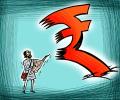
Historically, there has been no correlation between growth in bank credit to industry and lower benchmark interest rate

Fund managers's compensation is largely tied to the assets they manage and scheme performance.
The combined interest payment for India's top listed companies, excluding financial and oil and gas firms, was up 15.2 per cent year-on-year during the six months ended March 2019, outpacing the change in net sales and operating profit.

Nearly three-fourths of the debt money, as of April 30, 2019, was invested in securities with duration of less than three years.

'The variables to watch include the monsoon, resolution of NBFC liquidity issues, GST collections, and NPA resolution.'

More asset sales may be only way out, though most of the group companies' ratings have been downgraded and their combined market value is now a fraction of their combined debt.

As share of cash volumes in trading mix sees decline, it will result in moderation of profitability from core broking operations.
 © 2026 Rediff.com - Advertise with us - Disclaimer - Privacy Policy - Sitemap - Feedback - About us - Terms of use - Grievances